
Mechanized Parachute Training System
With its sleek, fully automated design, the Singapore Air Forces Airborne-trooper Training Facility (ATF) offers a more immersive and progressive training experience for soldiers completing the Basic Airborne Course (BAC).
* This page contains adapted & paraphrased content from Pioneer Magazine, Jan 2015
Boasting Three Progressive Systems
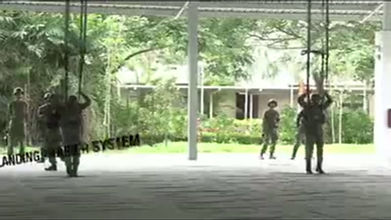
AEG Pte. Ltd. played a key role in providing the integrated Airborne-trooper Training Facility to the Singapore Air Forces. Designed to support progressively structured training for the BAC, the facility comprises three systems within the Parachute Training Facility: the Landing Trainer System (LTS), Rotational Trainer System (RTS), and Airborne Trainer System (ATS) in sequence.

Advanced Control Features for Dynamic Training
The first stage, the Landing Trainer System (LTS), introduces trainees to proper parachute landing fall techniques. Instructors can adjust the system to raise trainees to heights of 4 m or 8 m and release them at controlled descent rates of 2 m/s, 3 m/s, or 4 m/s, allowing training intensity to be progressively increased.
Sophisticated Mechanisms for Training Excellence
In the second stage, the Rotational Trainer System (RTS), trainees learn to control their parachutes by pulling the toggles. The fully automated system responds by rotating trainees in the direction of the applied input, simulating in-air maneuvering. For entanglement training, the system deliberately twists the suspension lines to recreate canopy entanglement scenarios, requiring trainees to execute corrective actions such as kicking or twisting to resolve the situation.


Realistic Simulations of Actual Conditions
The final stage utilizes the Airborne Trainer System (ATS), which delivers a highly realistic flight experience from aircraft exit to landing. Using a 200 m inverted monorail, trainees are able to conduct complete flight drills and practise emergency procedures under simulated airborne conditions.